How to choose a pedalboard power supply? It might not be the most glamorous decision in your board building, but it will save you from a daisy chain hum cascading through your setup and messing up your FX chain. Our happy PowerPlant family has grown over the years into one of the most complete power ranges out there, running all the way from a five-output entry box to a full modular, switchable-output engine. Here's how the range breaks down. Board boss Benedict will give us a brief overview in this video of all the PowerPlants in our range, and we’ll figure out below which one deserves a spot under your board.
You are currently viewing a placeholder content from YouTube. To access the actual content, click the button below. Please note that doing so will share data with third-party providers.
Do I Need a Specific Voltage for My Pedalboard Power Supply?
Yes. It is very important to match your voltages. You can kill your pedal by plugging into a power supply with too high voltage for it to handle. The majority of effects pedals run on 9V DC with a centre-negative polarity, so every PowerPlant in the range defaults to that as its baseline output. But most isn’t all. Some pedals may ask for 12V, 15V or 18V. “So why not just use an 18V power supply for all pedals?” You may ask. Well, you should never plug your 9V pedal into a higher power supply. It can be done occasionally with some pedals for effect (e.g. fuzz pedals), but in most cases it will lead to malfunctions. Similarly, never plug an AC power supply into a DC pedal. Doing so, the consequences range from: pedal doesn’t work, to: pedal is now dead. Conversely, when it comes to current, it’s always a good idea to leave some headroom. So plugging in a pedal that requires 100mA into a 300mA output is AOK. Always check the back of the pedal in question or its manual for the voltage and current draw before matching it to an output.
The OGs: PowerPlant and PowerPlant Junior
So which supply do you need? A good starting point are the original PowerPlant and its smaller sibling, the PowerPlant Junior. The Junior keeps things simple: five galvanically isolated 9V DC outputs at 120mA each packed into a compact steel housing, so noise picked up by one pedal never bleeds into the next. For a standard board of overdrives, a tuner, and maybe a delay, it does the job it’s designed for. The Junior comes with a fixed cable which is only compatible in the EU.
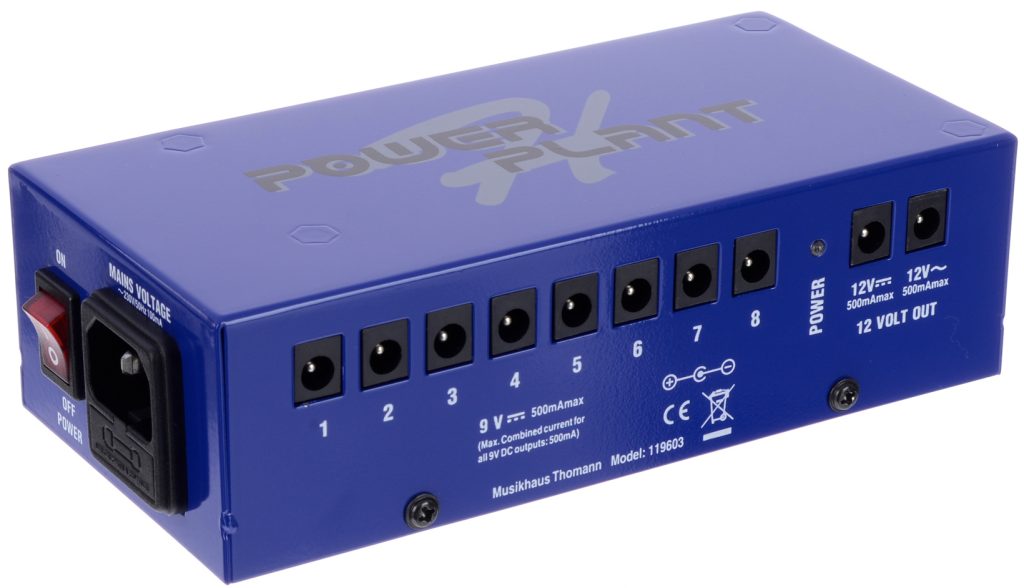
The original PowerPlant steps things up with ten outputs: eight 9V DC connections with a combined total of 500mA, plus a 12V DC and a 12V AC output at 500mA each. The AC output is included specifically for older or AC-only pedals that a standard DC brick can’t run. Between the two, the OGs cover the two most common starting scenarios: a small basic board, or a slightly larger one that might include a legacy pedal with more unusual power needs. The PowerPlant has an exchangeable cable slot and is compatible only in countries running on 230V/50Hz.
The OG: The PowerPlant
The Range: ISO Pro PowerPlants
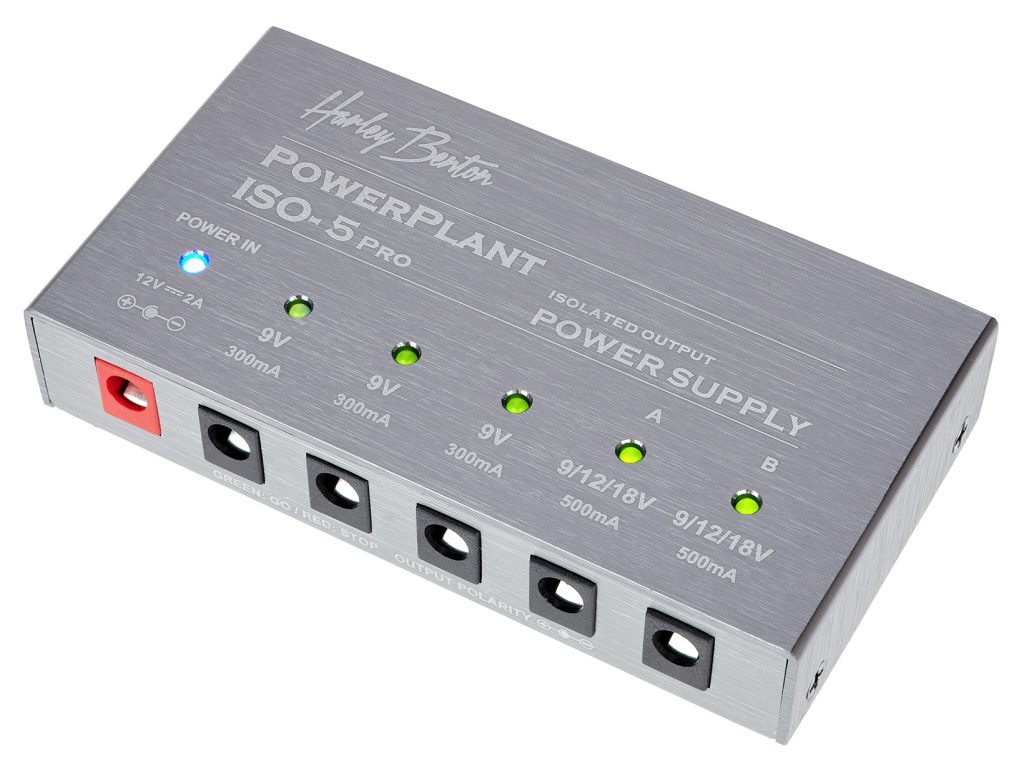
Our ISO range is something of a level up: multiple individually isolated outputs in a smaller sized casing. “The size of two small chocolate bars” says Bene describing our ISO 5 Pro. The ISO series starts to introduce switchable 9/12/18V outputs meaning one power supply can cover a mixed board without needing a separate brick for one outlier pedal. Every output gets its own status LED, so troubleshooting a dead pedal mid-soundcheck doesn’t mean unplugging everything one cable at a time.
The ISO models differ primarily in scale: the ISO-1 Pro has a simple eight 9V DC outputs at 500mA. The ISO-5 Pro is a smaller model with just five outputs, but two are switchable between 9/12/18V. The ISO-2 Pro is a step up with eight outputs, two of which are switchable. The ISO-12 Pro is a mammoth with twelve outputs, three switchable. The ISO-10AC Pro moves into larger territory with ten isolated outputs, four switchable; plus a USB output and an AC input which operates on 100–240V, so you can use it almost anywhere internationally. As you can see the ISO range has a lot of variety, which one works best for your board is just a matter of personalisation!
The ISO 5 Pro: small as a chocolate bar with two switchable outputs
The Expander: ISO AC Pro Modular
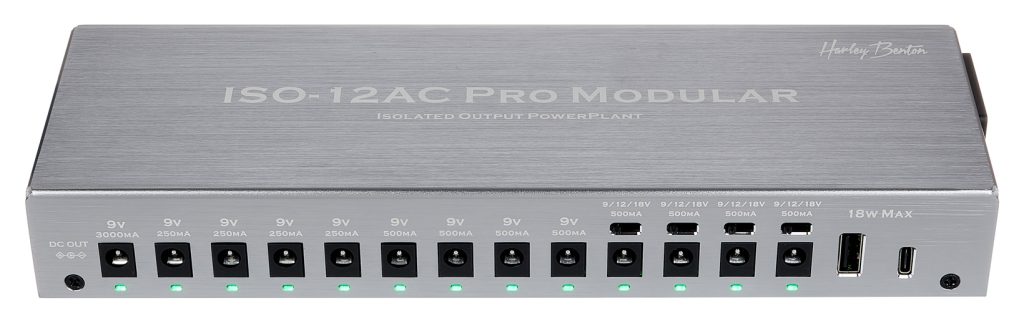
And finally, we have the AC Pro Modular series. The “Modular” means multiple units link together via a kettle-style AC connector, so a board that outgrows one PowerPlant can simply gain a second rather than needing a replacement supply: they become stackable to grow with your board. The ISO-1AC Pro Modular has a simple five 9V DC outputs, the ISO-2AC Pro Modular has five switchable outputs, and the ISO-12AC Pro Modular is a beast with thirteen outputs in total: twelve individually isolated plus one high-current, non-isolated output built specifically for power-hungry multi-effects units, plus USB-A and USB-C ports for keeping a phone or tablet topped up, built less like a power brick and more like an electrical hub for an entire rig. The AC Pro series all run on AC input on 100–240V and can be used internationally.
The ISO-12AC Pro Modular with thirteen total outputs
Can I Use a Battery Instead of a Pedalboard Power Supply?
Technically, yes. Plenty of classic pedals were designed around a 9V battery, and plugging one in will work. Whether it’s a good idea or not depends on what’s on your board. For a single analogue pedal or two, a battery is fine. For anything more than that, batteries become a liability. Multiple pedals means multiple batteries to track, digital pedals draw power far quicker than a battery can sustain, and a battery dying mid-set isn’t an ideal scenario. So a power supply quickly becomes a necessity to avoid gambling on when your board goes quiet.
The PowerPlant range is perhaps a growth path: Junior and the original Power Plant get a first board off batteries and daisy chains, the ISO series scales up with more flexibility, and the AC Pro Modular series is for expandable boards and international use. Wherever your board is on that spectrum, there’s a PowerPlant for that stage. More questions on power supply? Don’t hesitate to contact us and we’ll be happy to help. And if you want to learn more about electric guitar setups like: what are the benefits of tube amps? or setting guitar tone on a modeling amp then we’ve got’ya covered.
FAQ:
Will the power supply fit under my pedalboard?
Sure! Many people mount their power supply underneath their board to save space. The ISO Pro PowerPlants are especially beneath-board friendly due to their compact size.
What is the polarity of the effects units?
Centre-negative polarity is the PowerPlants default. You may need a cable to reverse the polarity if your pedal is wired centre-positive.
Do the connectors fit my effects units?
The PowerPlant cables use the standard 5.5mm x 2.1mm barrel connector that connects to most modern pedals. Especially with older effects units, today’s connectors sometimes don’t fit, in which case you may need an adaptor to connect them.
Featured Products
You need to load content from reCAPTCHA to submit the form. Please note that doing so will share data with third-party providers.
You are currently viewing a placeholder content from Facebook. To access the actual content, click the button below. Please note that doing so will share data with third-party providers.
You are currently viewing a placeholder content from Instagram. To access the actual content, click the button below. Please note that doing so will share data with third-party providers.
You are currently viewing a placeholder content from Instagram. To access the actual content, click the button below. Please note that doing so will share data with third-party providers.